DRIVEN BY PURPOSE. FULFILLING THE PROMISE.

ABOUT

Fulfilling the Promise

University of The Bahamas is on a focused and determined path to achieve both international and national accreditation – systems of continuous improvement – as we serve our mission of supporting and driving national development. A voluntary, peer-reviewed process, accreditation validates the quality of our academic programmes and the effectiveness of our broad range of services.

UB is pursuing national accreditation with the National Accreditation and Equivalency Council of The Bahamas (NAECOB) with which it is registered. UB is also now a candidate for accreditation with the Southern Association of Colleges and Schools Commission on Colleges (SACSCOC), a key step in the accreditation process.

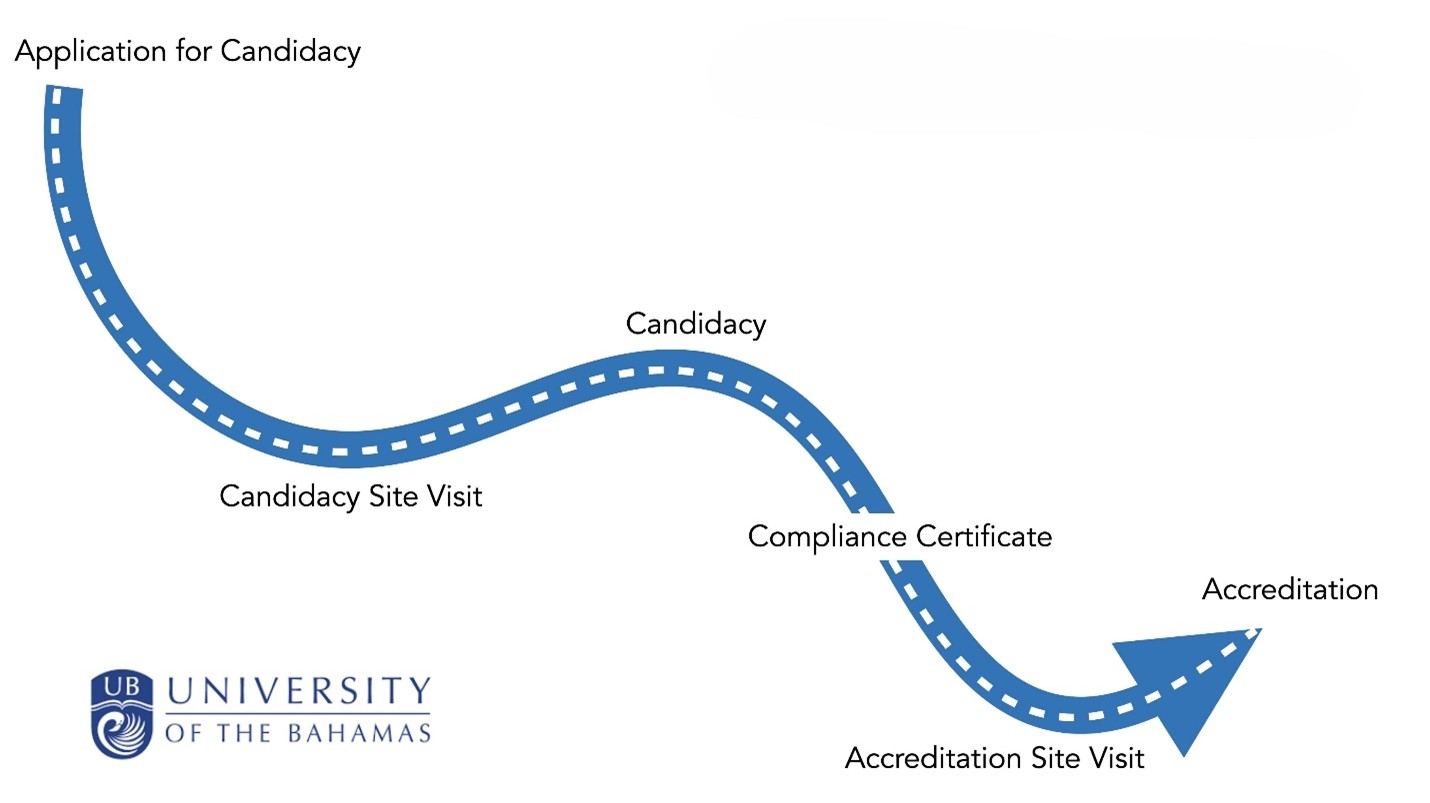
The awarding of candidacy was announced at the SACSCOC General Meeting on 7th December 2025. It symbolises that the institution has demonstrated compliance with the requirements and relevant standards required in the SACSCOC Application for Membership. There are more milestones to achieve in the process. For the accreditation roadmap, click here.

Read more about UB’s legacy grounded in purpose and promise. Click here.

What is Accreditation?

Accreditation is a process that supports a culture of continuous improvement and excellence in all that we do. It involves cycles of reviewing, assessing and enhancing how we operate as an academy as we remain missionfocused, resulting in operational efficiency and enhanced policies, and procedures.

Qualified external agencies and peer institutions are a part of the process and provide the validation of quality assurance. This cultural shift signifies to external and internal stakeholders that the University meets the quality standards expected of a recognised member of the national and international community of universities.

UB aims to become the first institution in The Bahamas to be accredited nationally as a validation of its quality academic programmes, support services and administrative operations.

UB is simultaneously pursuing international accreditation as a member of and contributor to the international community of universities.

By its very nature, a university is an international enterprise. Successful universities recruit faculty from jurisdictions, seeking the ones most likely to carry out outstanding scholarly work as teachers and as researchers. Internationalisation has become a driving force to bring together students from different backgrounds to prepare them for a global society and recruit faculty with a record of outstanding scholarly work. International accreditation is a pivotal part of attaining that global recognition.


How Will We Be Better?

Student success-focused excellence is at the core of our teaching, learning, research and service. Accreditation strengthens our capacity to support students and the broader community in academic, professional, and personal aspirations in the following ways:

  • Accreditation provides clear, ongoing evidence that a university maintains trusted academic quality and institutional integrity.
  • Students, families, and the public can invest with confidence, knowing the institution meets and maintains established standards of reputation and value.

  • Accrediting organisations verify qualified faculty, rigorous curriculum design, strong student support services, effective governance, and financial stability.
  • Accreditation protects students by ensuring their education is credible, meaningful, and aligned with recognised quality benchmarks.

  • Accreditation affirms that a university is respected and recognised by other reputable higher education institutions that are its peers.
  • This peer validation symbolises that the institution delivers quality education, programmes, and student services that meet accepted academic standards.

  • Accreditation reflects active membership in a community of universities committed to accountability and excellence. It is not about penalties or control.
  • Institutions voluntarily pursue accreditation to demonstrate dedication to high standards, transparency, and continuous improvement.
  • Degrees from accredited universities are more widely recognised by employers, professional organisations, and other universities worldwide.
  • As education and careers become increasingly global, accreditation supports student mobility for international study and employment opportunities.

Accreditation FAQs

Accreditation confirms that a university is recognised and respected by other reputable higher education institutions and that the institution meets accepted academic standards for education, programmes, and student services.

Accreditation protects students by ensuring they receive a credible, meaningful, and rigorous education. It verifies qualified faculty, strong curriculum design, effective student support, sound governance, and financial stability.

No. Accreditation is not about penalties or control. It represents voluntary membership in a community of universities committed to accountability, transparency, and continuous improvement.

Yes. Degrees from accredited universities are more widely recognised by employers, professional organisations, and other universities worldwide, supporting opportunities for global study and employment.

Accreditation provides ongoing public evidence that a university maintains high academic quality and institutional integrity. This helps students, families, and the public make confident, informed decisions.

Universities pursue accreditation voluntarily to demonstrate their commitment to excellence, continuous improvement, and delivering high-quality education that meets and maintains recognised standards.

Accreditation supports faculty by promoting academic quality, continuous improvement, and participation in peer review that strengthens teaching, scholarship, and programme effectiveness.

Accreditation provides clear standards for institutional effectiveness, accountability, and student support. This helps staff align services and operations with recognised measures of quality.

Members of the public can stay informed about institutional quality and provide feedback through established mechanisms, or when opportunities are available. The public can also hold accredited institutions to their commitments of accountability, transparency, and high educational standards.

Our Stories

SACSCOC President on Accreditation Candidacy Milestone in Institutional Effectiveness

President Dr. Robert Blaine, III, on the “On The Record” Show Explains New Vistas of Opportunity for UB

Vice Chair of the Board of Trustees Mr. Gadville McDonald on the “On The Record” Show Affirms Transformational Impact of Continuous Improvement

University Drive Podcast: The Perpetual Pursuit of Better

Driven by Passion; Steeped in Purpose

Building Capacity for Stronger Systems

Get The Latest Updates

Subscribe to our Newsletter

Subscription Form

Contact Us

For more information, to give your feedback, or to get involved in our journey of continuous improvement, contact us:

Address

Office of Institutional Strengthening and Accreditation
Keva M. Bethel Building
University of The Bahamas
Oakes Field Campus

Quick Links

Contact Us

For more information, to give your feedback, 

or to get involved in our journey of continuous 

improvement, contact us:

Address

Office of Institutional Strengthening 

and Accreditation 

Keva M. Bethel Building 

University of The Bahamas 

Oakes Field Campus

Quick Links

Copyright © 2026 University of The Bahamas